



Zugdidi Botanical Garden
Link copied
Photograph: Lika (Public domain)
The palace garden of the princes of Mingrelia in the centre of Zugdidi, begun in 1840 by David Dadiani and turned by Ekaterine Chavchavadze-Dadiani, with the Trieste gardener Babini, into a European ornamental garden: dug up by the Ottomans in 1856, restored from 1869 and enlarged from 1896 by the Zamberletti brothers of Varese, with 1,182 metres of plane-tree alleys, an artificial lake and exotic plants of some eighty genera; today a botanical garden and a cultural heritage monument.
About
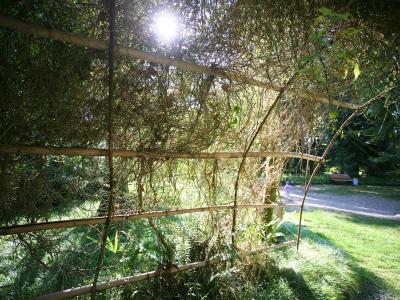
Zugdidi Botanical Garden lies in the centre of the city beside the Dadiani Palace and is the Zugdidi branch of the Central Botanical Garden of the Georgian Academy of Sciences; it was laid out in the nineteenth century as the ornamental garden of the princely residence and is a cultural heritage monument. In the park grow trees, shrubs and plants of many species from some eighty genera: six species of magnolia, various oaks, the Atlas and the Himalayan cedar, relict and endemic plants brought from Asia, India and Japan among them, from the Mediterranean and from America. The garden is planned in the symmetrical French style, with ornamental plots and artificial landscapes skilfully matched to natural corners left here and there; the artificial lake with its island survives, as do the box borders, the alleys of giant plane trees that cut across the garden to a total length of 1,182 metres, and a hornbeam alley 187 metres long that grew from the stumps of trees the Ottomans cut down.
By its position and climate the Zugdidi garden is one of the best bases for the introduction, study and acclimatisation of valuable subtropical plants; from the day of its planting it became the centre for introducing foreign plants to Mingrelia, from which hundreds of species spread widely among the population and many gardens and squares were planted in the villages, townships and towns of the region.
- Safety notes
- Take care beneath the old trees in windy weather
History
According to Iona Meunargia, Rapiel Eristavi and Kornely Borozdin, in 1840, when David Dadiani received power from his father Levan V, he fenced part of the forest around the palace, declared it the palace garden and established permanent posts for gardeners; he soon entrusted the care and management of the garden to his wife, Ekaterine Chavchavadze-Dadiani, who invited the gardener Joseph Babini from Trieste as its chief builder. Babini cleared the garden of unsuitable plants, planned it in the symmetrical French style, laid out the plots and created artificial landscapes and a nursery. After David's death in 1853 the garden passed wholly into Ekaterine's hands, but in 1855 Mingrelia became the theatre of Omar Pasha's 30,000-strong Ottoman army, and in 1856, on the orders of Iskander Pasha, the commander of a garrison harried by the Mingrelians, the garden was dug up by the roots and destroyed; on 2 February 1856 Ekaterine reported the calamity by letter from Gordi to Platon Ioseliani.
After the peace restoration work began, and full restoration became possible from 1869, after Ekaterine's return from France; in 1896 the brothers Gaetano and Giovanni Zamberletti, invited from Varese, brought seeds and seedlings of rare exotics from St Petersburg, enlarged the grounds according to the master plan and planted the plane-tree alleys. With Ekaterine's death in 1882 the introduction of exotics ceased; the deaths in 1903 of Niko Dadiani and of the aged Gaetano Zamberletti let the garden's upkeep decline; until 1917 it was managed by the Dadianis' agent, and in 1917–1921 by the zemstvo. In 1922 the People's Commissariat of Education appointed Akaki Chanturia director, in 1924–1926 the garden came under the agricultural college, and from 1926 under the Tbilisi Botanical Garden, whose director, Professor Lomouri, had the garden, damaged by grazing cattle and lack of protection, surveyed, fenced and given a director with higher education.
Visit info
The garden is in the centre of Zugdidi beside the Dadiani Palace. Check the opening hours and conditions of entry locally.
Safety
Take care beneath the old trees in windy weather. The garden is a scientific collection, so do not damage the plants.
Tip
Look for the six species of magnolia, of which the large-flowered magnolia flowers on into October, and for the hornbeam alley that grew from the stumps of the trees the Ottomans felled. See the garden in the same visit as the Dadiani Palace next door.
Sources
Nearby places
All places in the region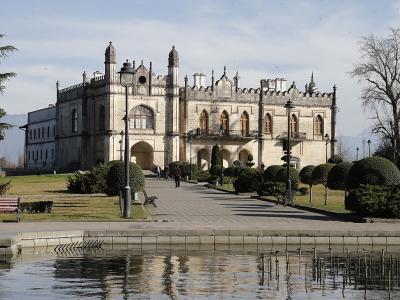
Places of the same kind
Park — all places
Nearby settlements