



Tsaishi Cathedral
Link copied
Photograph: Abkhazian1 (CC BY-SA 4.0), Lika2672 at Georgian Wikipedia (CC BY-SA 3.0)
A domed cathedral of the Dormition some ten kilometres from Zugdidi on the first hills above the Colchian lowland: one of the oldest episcopal sees of Georgia, listed as a diocese of Lazica in 602–610; the building of the turn of the thirteenth and fourteenth centuries was restored after the earthquake of 1614 by Bishop Malakia Gurieli, with a tenth-century "palati" and frescoes of the Virgin.
About
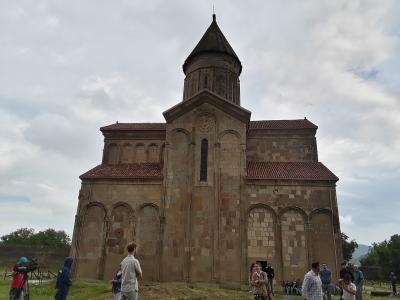
The cathedral of the Dormition of the Most Holy Mother of God at Tsaishi stands in the village of that name in Zugdidi Municipality, some ten kilometres south-west of the city of Zugdidi, where the hills begin above the Colchian lowland; it is the cathedral of the diocese of Zugdidi and Tsaishi and one of the oldest episcopal sees of Georgia. The domed church standing today was built at the turn of the thirteenth and fourteenth centuries, on the site of a hall church of the turn of the tenth and eleventh, and the earthquake of 1614 wiped out its original appearance: the cylindrical dome that crowns the composition is of the seventeenth century and lacks even the structural projections of the base square. The architect is unknown, though the name of a master builder Anania is read on one detail of the drum. Three building periods are distinguished in the monument, with layers of the tenth and the seventeenth centuries.
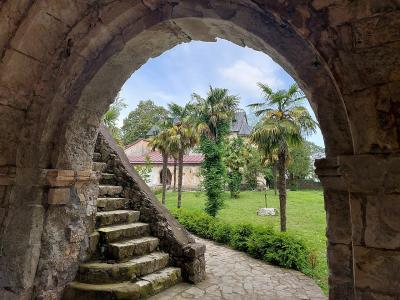
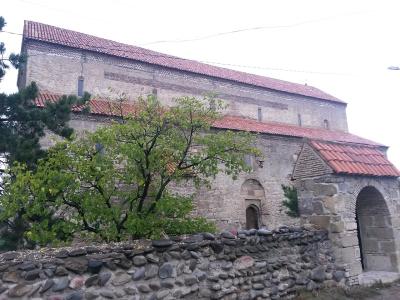
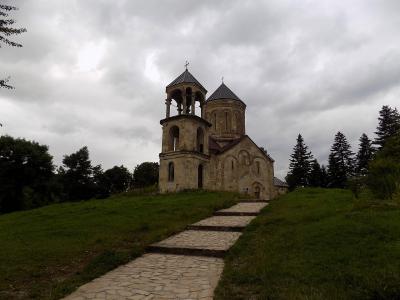
The oldest building of the complex is the "palati" outside the wall at the north-western corner, set against the slope: a building dated by its interior to the tenth or eleventh century, whose arched piers carry elements of the Gothic style, and above which once stood a wooden house held to be a finest example of woodcarving. Built into the wall on the south is a two-storey bell tower that contains several building layers and fragments of the church and was raised after the earthquake, as Malakia's inscription says: "it fell entirely, with its wall and its inner buildings and its bell tower". Among the frescoes of the interior stand out the standing Virgin with the Child and the archangels Michael and Gabriel in the conch of the sanctuary, and on the vault of the western arm the Virgin in a sphere with raised hands, in sharp, realistic folds. By the southern gate of the cathedral lies its late rector, Archpriest Amiran Shengelia.
- Century
- Turn of the 13th and 14th centuries; the dome 17th century, after the earthquake of 1614; the palati 10th century
History
By the turn of the sixth and seventh centuries there was already an episcopal see at Tsaishi: the list of sees compiled between 602 and 610 names the diocese of Tsaishi in Lazica, and the oldest Georgian record is the inscription of a processional cross of the turn of the tenth and eleventh centuries, where Ephrem, bishop of Tsaishi, is named beside Bagrat, king of the Abkhazians and kouropalates. The flock of the diocese at first lived between the Khobistskali and the Enguri, from the Black Sea to the Unagira range, and after the sees of Dranda, Mokvi and Bedia were abolished the people of Samurzakano joined it. Some twenty bishops of Tsaishi are known from the eleventh century to 1823, the most deserving among them Malakia II Gurieli (1612–1639) and Grigol Chikovani (1777–1823): Malakia quickly restored and adorned the cathedral, terribly ruined by the great earthquake of 1614, while Grigol, with the support of Katsia II Dadiani, recovered for the church the serfs and estates seized by the nobility, built the bell tower and enclosed the cathedral with a wall.
In 1823 the Russian government abolished the see of Tsaishi together with the other sees of Mingrelia; until 1879 there was a monastery here, then a deanery of 20 churches of the Zugdidi district, and a school worked at the cathedral, Tsaishi being a strong centre of learning. Under the Bolsheviks the cathedral was closed and abandoned; in 1989 worship was restored with the blessing of Catholicos-Patriarch Ilia II, and a congregation gathered. From then until the end of his life the rector was the diocese's senior confessor, Archpriest Amiran Shengelia; the present rector is Archpriest Zabulon Kobalia.
Visit info
Tsaishi lies some ten kilometres south-west of Zugdidi, about 12 kilometres by road, where the hills begin above the Colchian lowland. The cathedral is a working church; check opening times locally. See the "palati" outside the wall at the north-western corner and the bell tower built into the southern wall.
Safety
This is a working cathedral: dress modestly and keep quiet during services. The "palati" is built against the slope, so watch your footing after rain.
Tip
Inside, look for the standing Virgin with the Child in the sanctuary conch and the Virgin in a sphere on the vault of the western arm; on a detail of the drum is an inscription with the name Anania, perhaps the builder. Tsaishi fits into one day with the Dadiani Palace in Zugdidi and the Khobi monastery.
Sources
Nearby places
All places in the region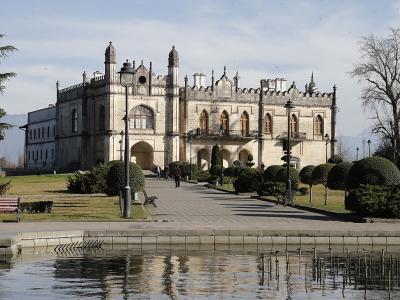
Places of the same kind
Cathedral — all places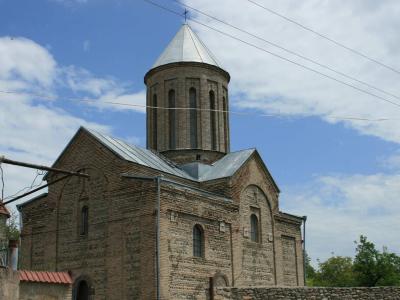
Nearby settlements