



Dadiani Palace
Link copied
Photograph: Giorgi Abdaladze (CC BY-SA 4.0), Kakhi Kuloshvili (CC BY-SA 4.0), Lika2672 (CC BY-SA 3.0), MIKHEIL (CC BY-SA 3.0), Karelj (CC BY-SA 3.0)
The neo-Gothic residence of the Dadiani, princes of Mingrelia, in Zugdidi, one of the most celebrated princely palaces of the Caucasus and a museum since 1849, which keeps the robe of the Mother of God, the icon of Queen Burdukhan, a death mask of Napoleon and up to 50,000 objects.
About
The Dadiani Palaces Historical and Architectural Museum stands in the centre of Zugdidi within the residence of the princes of Mingrelia: the Queen's palace, Niko's palace, the princely court church and around them a botanical garden laid out by Ekaterine Chavchavadze-Dadiani with gardeners brought from Europe. In the seventeenth century the Italian missionary Arcangelo Lamberti wrote that the prince had more than fifty palaces, that of Zugdidi the most beautiful of them. The present main building, the Queen's palace, was remodelled in 1873–1878 for Ekaterine Dadiani to a design by the architect Rice, who took the Vorontsov palace at Alupka as his model: the building is chiefly neo-Gothic with Georgian, Russian, Islamic and Tudor elements, arcades added on the second floor and broad wings. Niko's palace was built in the 1880s for the last prince, Niko Dadiani, by the Russian architect Leonid Vasilyev, a two-storey residence with a stone balcony and the largest ballroom in Georgia.
The museum's collections hold up to 50,000 objects. Its greatest treasure is the robe of the Most Holy Mother of God, brought to Georgia in 1453 after the fall of Constantinople, kept first in the Bedia cathedral and then in the Khobi monastery, and moved to the princely palace in 1533 by Levan I Dadiani; with it are kept the arm of St Marina, the hand of St Kvirike and relics of St George and John the Baptist in a silver reliquary inscribed with the names of Levan II Dadiani and Nestan-Darejan. Among the goldsmiths' work stand out the eleventh-century processional fan of King Giorgi, the twelfth-century icon of Queen Burdukhan, mother of Queen Tamar, with 52 relic cells, and a sixteenth-century triptych icon of St George; the museum also holds material from the Tagiloni treasure, a Colchian gold coin, manuscripts of the thirteenth and fourteenth centuries, the early seventeenth-century sabukhari of the chancellor, the oldest surviving piece of Georgian embroidery, and the epitaphios of Levan II Dadiani, manuscript books and charters of the sixteenth to nineteenth centuries, the correspondence of Grigol Orbeliani, Niko Nikoladze and others, the military archive of the Russian imperial court, and a collection of Caucasian, European and Asian arms. The objects connected with Napoleon, among them one of the emperor's three death masks, were brought by Salome Dadiani's husband Prince Achille Murat, grandson of Napoleon's sister Caroline.
- Century
- Queen's palace 1873–1878 (a remodelling of the earlier palace), Niko's palace in the 1880s
History
The museum was founded by David Dadiani, prince of Mingrelia, one of the first in Georgia, on the basis of his own treasury and of antiquities gathered from the churches and monasteries of Mingrelia: in 1840 the first exhibition of the archaeological finds from Nokalakevi was held in the palace, in 1848 David showed guests his archaeological and numismatic collection from Nokalakevi, and 1849 is counted as the museum's founding date. In 1866, after Niko Dadiani abdicated, his sister Salome left for Paris with her mother and on 18 May 1868 married Prince Achille Murat, grandson of Marshal Murat; Murat brought Bonapartist relics to Mingrelia. In 1873–1878 the Queen's palace was remodelled for Ekaterine Chavchavadze-Dadiani, sister of Nino Griboyedova, and in the 1880s Niko's palace was built. In 1919 the heirs of the Dadiani formally renounced their rights to the palace complex.
On 1 May 1921, on the initiative of the ethnographer and geologist Akaki Chanturia, the palace became wholly a museum, first as the "Museum of Mingrelia", then as the Zugdidi State Historical and Ethnographic Museum, and since 2005 as the Dadiani Palaces State Historical and Architectural Museum. In the mid-1990s Prince Alain Murat, great-grandson of Achille Murat and Salome Dadiani, settled in Zugdidi with his family, founded the fund "The Murats in Georgia" and laid claim to the Dadiani property including the palace; the Georgian Fund for the Rescue of the Dadiani Palaces points to the renunciation of 1919. On 26 May 2007 in Zugdidi President Mikheil Saakashvili announced the restoration of the palace, "the only surviving European palace of Georgia", of which the whole country should be proud.
Visit info
The palace stands in the centre of Zugdidi, in the middle of the botanical garden; check the museum's opening hours, admission and tour languages locally. Zugdidi has a railway station and is linked to Tbilisi by rail and by road; from Kutaisi the drive takes about two hours.
Safety
Ask at the museum about the rules for photography; do not touch the cases. The garden paths are slippery after rain.
Tip
Among the relics, look for the inscription on the silver reliquary, which names Levan II Dadiani and Princess Nestan-Darejan. The palace fits into one day with the Khobi monastery and Nokalakevi.
Sources
Nearby places
All places in the region
Places of the same kind
Palace — all places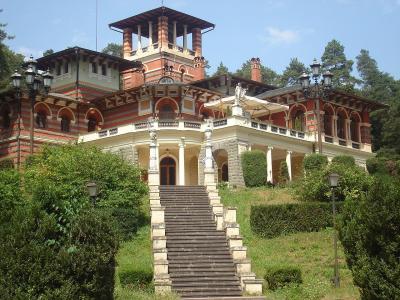
Nearby settlements