



Rukhi Fortress
Link copied
Photograph: Jelger Groeneveld (CC BY 2.0), Abkhazian1 (CC BY-SA 4.0)
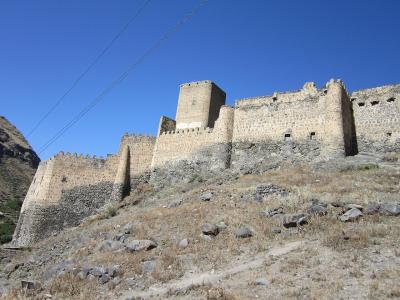
Levan II Dadiani's seventeenth-century fortress on a hill of the left bank of the Enguri, 7 kilometres from Zugdidi: the chief stronghold of the principality of Mingrelia, with a citadel, walls of 10–12 metres and an artillery tower, the site of the battle of Rukhi against the Ottomans in 1779, which Chardin in 1671 called the principal castle of Odishi.
About
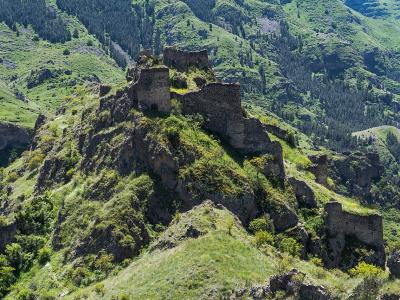
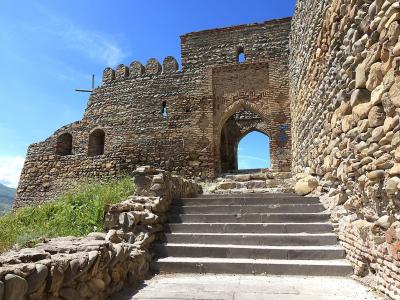
The Rukhi fortress, in Mingrelian Rukhish Jikha, stands in the village of Rukhi in Zugdidi Municipality on the left bank of the Enguri, 7 kilometres from the centre of Zugdidi, on a hill. It is a medieval fortress consisting of a citadel and a lower court: the citadel occupies the northern part, with a tower at either end of its elongated court, the north-eastern one serving as the keep, while the lower court takes up the southern slope of the hill. The fortress is ringed by a wall 10–12 metres high, blind for its lower 8–10 metres and carrying a wall-walk above; the entrance is through the ground floor of a tower built into the wall, and in the south-western part of the wall stands another tower that held artillery. Jean Chardin, who passed here in 1671, named Rukhi the chief of the nine or ten castles of Mingrelia and remarked that its wall was of stone but weak and thin, so that any cannon could breach it, though the castle held several cannon, which was the case nowhere else in Mingrelia. Some suppose the Rukhi fortress to have been part of the system of the Kelasuri Wall.
- Construction period
- 1647 by Vakhushti's account, probably ten years earlier; Levan II Dadiani
History
The Rukhi fortress was built by Levan II Dadiani, prince of Mingrelia, in 1647 according to Vakhushti Bagrationi, though it is thought to have been built ten years earlier; in 1634–1635 a rabat settlement grew up beneath it and soon decayed, and Arcangelo Lamberti describes Rukhi as a town. In 1661 Vakhtang V, king of Kartli, took the fortress during his war with Mingrelia; in 1672 Prince Levan III Dadiani sheltered here from the Ottomans. In 1703 the Ottomans, having occupied Batumi and Poti, reached Rukhi and destroyed the fortress; in 1723 it was in Ottoman hands and from time to time held their garrison, until in 1770 a joint Georgian and Russian army freed it.
In 1779 at the Rukhi fortress the army of Imereti, Mingrelia and Guria crushed the Ottomans, the battle of Rukhi, which by some accounts was fought in 1790, and by others against an Abkhazian army; in 1795 an Ottoman-Georgian battle was fought at the fortress with the participation of King Solomon of Imereti. During the Crimean War, in 1855, Russian troops and the Georgian militia defeated an Ottoman expeditionary corps near Rukhi; after that the fortress gradually lost its importance and fell into ruin. It is a cultural heritage monument (heritage portal no. 8441).
Visit info
Rukhi lies about 7 kilometres by road north of the centre of Zugdidi; the fortress stands on a hill in the village, on the left bank of the Enguri. The fortress survives as a ruin, so check access locally.
Safety
The walls are 10–12 metres high and in ruins: do not climb them. The Enguri marks the edge of Georgian-controlled territory, so do not walk towards the dividing line.
Tip
Look for the north-eastern keep, the south-western artillery tower and the entrance through the ground floor of the tower built into the wall. Rukhi fits into half a day with the Dadiani Palace in Zugdidi.
Sources
Nearby places
All places in the region
Places of the same kind
Fortress — all places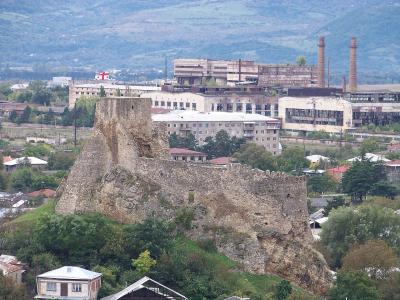
Nearby settlements