



Sapara Monastery
Link copied
Photograph: Bakur Gelashvili (CC BY-SA 4.0), Jaba1977 (CC BY-SA 4.0), Kober (CC BY-SA 4.0), John Mawer (Public domain), Unknown author (Public domain)
A medieval monastery in a forested gorge near the village of Ghreli, 10 kilometres from Akhaltsikhe: one of the residences of the Jaqeli lords of Samtskhe and their family burial place. Here stand the tenth-century church of the Dormition, the domed church of St Saba built under Beka Jaqeli at the turn of the thirteenth and fourteenth centuries, one of the oldest bell towers in Georgia, the ruins of a palace and a castle, and fourteenth-century frescoes with portraits of the Jaqeli princes. Today it is a working monastery.
About
Sapara Monastery lies in a green, forested gorge near the village of Ghreli in Akhaltsikhe municipality, 10 kilometres from Akhaltsikhe. Its name means sheltered, and it suits the place: the monastery is hidden among dense forest and yellowish cliffs. It occupies a narrow strip of mountainside, its buildings set at different levels on both sides of the path from the entrance to the main church, and its pink and yellow stone stands out against the green of the gorge. Once the seat of the atabegs of Samtskhe, it was a true fortress: above the monastery to the west stand the ruins of an old castle, from which a long wall begins whose remains are still clearly visible on the north and west. The road from Akhaltsikhe ends right here. The grounds hold churches, a bell tower, monks' cells, farm buildings and the ruins of the Jaqeli palace; by some accounts there were 12 churches here.
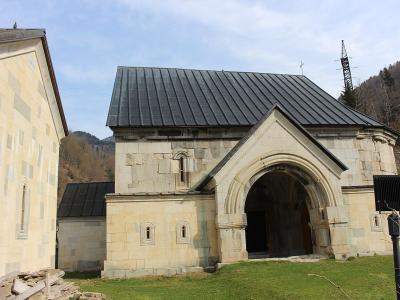
At the gate in the wall, on the edge of the cliff, is the small single-nave chapel of St Stephen. On the right of the path to the main church are vaulted rooms of rubble stone built against the rock, and further on the ruins of a palace of dressed stone. The oldest building of the complex is the single-nave church of the Dormition of the tenth century. In its western part is a gallery on columns that spans the whole width of the hall, and on the same side it has an annex like a porch but closed by walls. The church is known for its rich carving: when restoration removed the nineteenth-century lime plaster from its walls, hidden frescoes and many carvings came to light. The painting belongs to the first half of the fourteenth century. The church's chancel screen, carved from soft green stone with reliefs of the Annunciation, the Presentation and the meeting of Mary and Elizabeth, shows the high level of eleventh-century stone carving and is now kept in the Art Museum of Georgia.
The main building is the domed cross-in-square church of St Saba, which rises on the edge of a sheer cliff: to build it, a special support had to be raised on the rock ledge. The architect Parezasdze is named in the inscriptions of the church and the porch window. The drum of the dome has 16 windows, 8 real and 8 blind, the blind ones framed just like the real ones. The west porch is unusually tall, and its open arches and star-shaped vaults are richly carved; the building carries many inscriptions. The tympanum of the north entrance shows a cross and two medallions with birds. Of the fourteenth-century painting, the lower part of the south wall shows St Saba and the Jaqeli rulers of Samtskhe, Sargis I, Beka I, Sargis II and Kvarkvare, with the Great Feasts above them; the west wall has Biblical scenes and the Last Judgement, the apse the Deesis and the Eucharist, and the dome the Ascension.
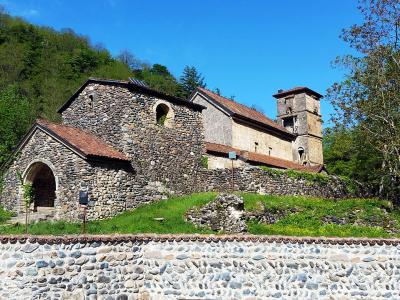
The bell tower was built of dressed stone at the end of the thirteenth or the start of the fourteenth century and is counted among the oldest bell towers in Georgia. It has two storeys: the upper one is an open arcaded pavilion, the belfry proper, and the lower one the family tomb of the Lasurisdze, vassals of the Jaqeli, granted to them by Beka. The frescoes that survive here show members of the Lasurisdze family: Lasuri, Sumbat and the priest Nikoloz. The palace, held to date from Beka's time, survives only as one storey: two large rectangular rooms of dressed stone, without a roof. Above the entrance of the small church of St George is an inscription saying that this small hermitage was built by Grigol Napshvuenisdze, the spiritual father of Sapara, for the holy fathers settled at Sapara.
- Tradition / order
- Georgian Orthodox Church; a monastery of monks in the eparchy of Akhaltsikhe and Tao-Klarjeti
History
The monastery has existed since at least the ninth century. Many important figures of Georgian church history worked here: chief among them Catholicos Arsen I (ninth century); in the tenth–eleventh centuries Ivane and Gabriel Sapareli worked here, in the twelfth century Ioane Mtbevari-Sapareli, at the turn of the twelfth and thirteenth centuries the scribe Ephrem, in the sixteenth century the calligrapher Svimeon Kargareteli, and in the eighteenth–nineteenth centuries the copyists Mitrofane Sapareli, Kristesia Samadashvili and others. At the end of the thirteenth century Sapara became a possession of the Jaqeli family. Sargis Jaqeli, ruler of Samtskhe, kept on good terms with the Mongols, and thanks to this Samtskhe enjoyed a peace rare for the time. In old age Sargis took monastic vows and the name Saba, and his son Beka built the largest church here and named it after the saint of his father's monastic name, St Saba. In the thirteenth–fourteenth centuries the Jaqeli made Sapara their residence and family burial place; in the first half of the fourteenth century, by order of Beka's sons Sargis, Kvarkvare and Shalva, the church of the Dormition was thoroughly repaired and fully painted, and they themselves are shown beside the chancel screen.
At the turn of the sixteenth and seventeenth centuries, after the Ottomans established themselves in Samtskhe, Sapara emptied, and its icons and other treasures were taken to safer parts of Georgia: the monastery's chief icon, that of St Saba, was placed in the church of the village of Chkhari in Imereti, and part of the treasure ended up in the village of Ardeti in Kartli. A charter of King Teimuraz I of 1630 confirms that the abbot of Sapara, Arsen Avalishvili, had been driven out of the monastery about that time. In the first half of the eighteenth century, according to Vakhushti, the beautifully built, domed monastery of Sapara was left with a single priest; a priest of Sapara, Giorgi Zedatmogvi, is named in an inscription of 1773.
In the nineteenth century the monastery was completely abandoned and in ruins. Religious life began again here from the 1850s: at first Georgian monks settled in the monastery, in 1877–1878 the monastery was plundered by Muslims, and in 1893 it was restored and a Russian monastery was founded here, which lasted until the Soviet period. In Soviet times Sapara was closed, and its revival began in the 1980s, before Georgia regained its independence. Today it is a working monastery, and the complex is on the list of immovable cultural monuments of national significance.
Visit info
Sapara is 10 kilometres from Akhaltsikhe, in the forest near the village of Ghreli; the road from Akhaltsikhe ends at the monastery. The monastery can be reached from Akhaltsikhe by various kinds of transport, and some pilgrims and travellers walk the whole 10 kilometres to enjoy the scenery. It is a working monastery. Check entry arrangements and the schedule of services on site.
Safety
This is a working monastery: dress modestly, do not take photographs during services and do not touch the frescoes. The church of St Saba and other buildings stand on the edge of a sheer cliff, so keep away from the edge. Take care on the forest road in winter and after heavy rain.
Tip
In the church of St Saba look at the lower part of the south wall, where Sargis I, Beka I, Sargis II and Kvarkvare Jaqeli are painted, and at the medallions with birds in the tympanum of the north entrance. In the church of the Dormition look for the portraits of Beka's sons Sargis, Kvarkvare and Shalva, and on the ground floor of the bell tower are the portraits of the Lasurisdze. The ruins of the Jaqeli castle stand above the monastery to the west; to see the church's chancel screen itself, visit the Art Museum of Georgia.
Sources
Nearby places
All places in the region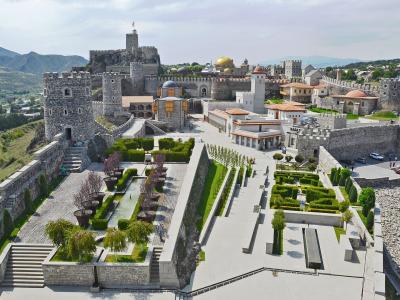
Places of the same kind
Monastery — all places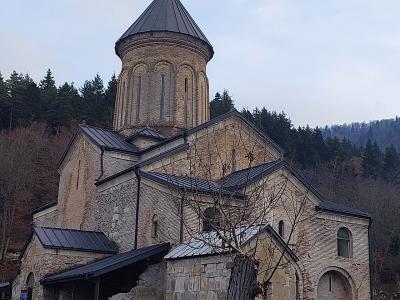
Nearby settlements