



Bzyb Fortress
Link copied
Photograph: feathero (CC BY-SA 2.5), karel291 (CC BY 3.0), Unknown author (Public domain), Sergei Prokudin-Gorskii (Public domain)
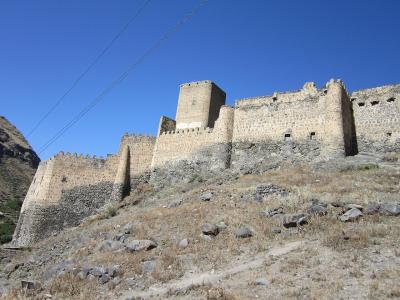
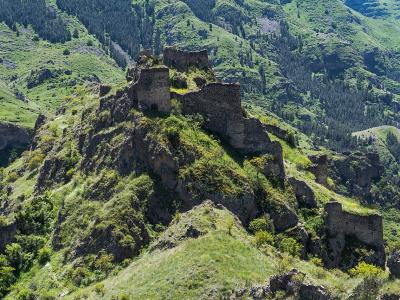
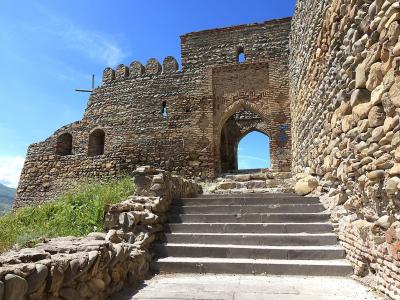
A fortress of the age of the Kingdom of the Abkhazians on the right bank of the Bzyb, closing the valley and the pass towards the North Caucasus: walls of dressed ashlar with rectangular and semicircular towers, and in the upper court the ruins of a cross-domed church of the second half of the ninth century.
About
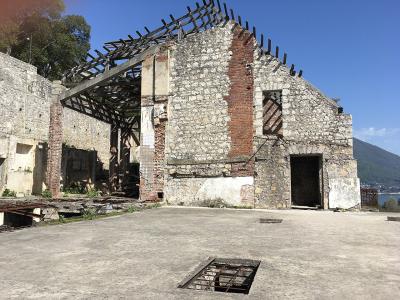
The Bzyb fortress stands in the village of Bzyb in Gagra Municipality, on the right bank of the Bzyb. It consists of two parts: in the upper part stood the church, while an old road ran through the court of the lower part. The fortress closed the Bzyb valley and the crossing of the river, for up the valley ran one of the pass routes to the North Caucasus. Its walls are built of well-dressed limestone ashlar and carry rectangular and semicircular towers, buttresses and a gate.
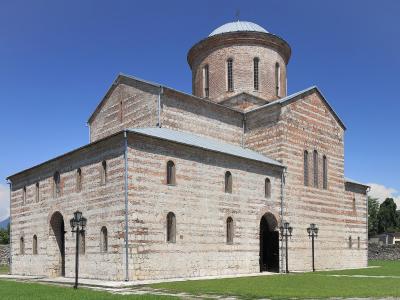
The church of the fortress is a cross-in-square domed building set within the outer rectangle of its walls, with three projecting faceted apses on the east; it is dated to the second half of the ninth century, by some scholars to the tenth. The central apse is five-sided outside with three windows, the side apses three-sided with one window each. Inside, four free-standing piers divided the space into nine bays and carried the drum of the dome on pendentives; dome and drum were octagonal outside. The church has three entrances, from the north, south and west, each with a porch built against it. The walls are faced with dressed stone; the doors and windows are framed by reliefs of twisted rope and concentric circles, and in the arch of the upper window of the south façade a slab with a relief of three crosses survives. In its architecture the church is akin to the church of Tsandripsh. Only the ruins of the walls remain, the dome, vaults, piers and arches having collapsed; east of the church the remains of an older church are visible.
- Century
- Second half of the 9th to the 10th century
- Material
- Well-dressed limestone ashlar
- Restoration notes
- The church and walls are in poor condition and need urgent conservation; because of the occupation Georgia cannot carry out any work
History
The fortress and church belong to the heyday of the Kingdom of the Abkhazians, the second half of the ninth and the tenth century, and served to control the road up the Bzyb valley; the church, scholars suppose, may also have been the seat of the Byzantine bishop of Soterioupolis. East of the church lie the remains of an earlier church, pointing to a long ecclesiastical history of the site. Levan Rcheulishvili discusses the Bzyb church among the monuments of the domed architecture of Abkhazia of the eighth to tenth centuries.
The fortress decayed over the centuries; of the church only the ruins of its walls remain. On 7 November 2006 a decree of the President of Georgia listed the fortress as an immovable cultural monument of national significance. Because of the occupation Georgia can neither study nor conserve the monument; by the account of Georgian specialists both church and fortress are in poor condition.
Visit info
The fortress lies south-east of Gagra, about 18 kilometres by road, on the right bank of the Bzyb. The church is a ruin and has no roof. Check access to the site locally.
Abkhazia is an occupied territory. Under Georgian law entry to the region is lawful only through the Enguri crossing; entry from Russia is a breach of Georgian law. Check the current conditions of movement before travelling.
Safety
Climbing on the ruins is dangerous: the walls are unstable and the stone loose; do not go under the collapsed vaults. Consular assistance in the occupied territory is limited.
Tip
Look for the relief of three crosses in the arch of the upper window of the south façade and the twisted-rope framings of the doors and windows, the church's finest details.
Sources
Nearby places
All places in the region
Places of the same kind
Fortress — all places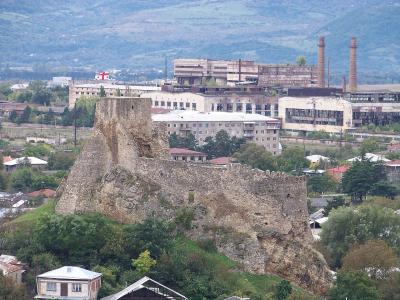
Nearby settlements