



Pitsunda Cathedral
Link copied
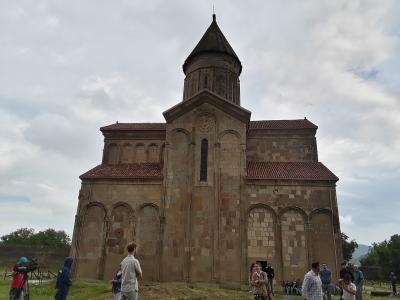
Photograph: Hons084 (CC BY-SA 4.0), Alexxx1979 (CC BY-SA 4.0), Teramo Castelli (Public domain)
A tenth-century cross-domed cathedral at Pitsunda, for centuries the seat of the Catholicoi of Abkhazia and today a concert hall with an organ installed in 1975: the largest early medieval church in Abkhazia.
About
The cathedral of the Mother of God at Pitsunda (in the Russian tradition the patriarchal cathedral of St Andrew the First-Called) stands in the settlement of Bichvinta, in Gagra Municipality, on the cape within the site of the old Roman fort of Pityus. It is the largest early medieval church in Abkhazia and a monument that belongs organically to the development of Georgian architecture, although its outward appearance also shows kinship with Byzantine buildings.
The cathedral is a cross-domed building with three naves and three apses, elongated in plan; it has a narthex on the west, which is rare in Georgia, and three projecting apses on the east. The plan with the apses measures 43.3 by 22.7 metres; the height to the top of the dome is 29 metres, and the walls are up to 1.5 metres thick. The walls rise from the plinth in blocks of stone and pass higher up into alternating courses of stone and brick, a technique typical of late Byzantine architecture; the drum of the dome is entirely of brick. The dome rests on the walls of the sanctuary and two piers; the western arm carries a gallery on three sides.
The interior was painted, but in the second half of the nineteenth century it was plastered over and whitewashed; of the old painting a band of medallions in the sanctuary survives, together with small fragments found during the restoration of 1966. In the south-west corner of the narthex is an apsed burial chapel whose painting of the second half of the sixteenth century shows the apostles Andrew and Simon the Canaanite. In 1975 an organ by the Alexander Schuke works of Potsdam was installed, and since then the building has served as a concert hall; the former cells house the Pitsunda museum. Since 2006 the cathedral has been a monument of national significance of Georgia.
- Century
- Turn of the 10th century; an earlier basilica of the 4th century
History
Pitsunda is the site of ancient Pityus, where the Romans built a fort in the second century. In the fourth century a basilica was raised within the fort; its bishop Stratophilus attended the Council of Nicaea in 325. At the turn of the sixth century the floor of that church was laid with a mosaic of local stone in twelve colours, one of the oldest mosaic floors in the Caucasus, with a Greek inscription. In the sixth century, under Justinian I, a new church was built here, and in 541 the first baptism of the Abkhazians took place at the episcopal see of Pitsunda.
The present domed cathedral was built at the height of the Kingdom of Abkhazia, at the turn of the tenth century; Georgian tradition links its building with Bagrat III. From the middle of the tenth century to the end of the sixteenth Pitsunda was the seat of the Catholicoi of Abkhazia, where the catholicoi were elected and bishops consecrated. Under the Ottoman threat the see moved to Gelati in the seventeenth century and the cathedral stood empty; according to Jean Chardin the catholicos came once a year to consecrate the chrism. In 1830 a twelfth-century Georgian manuscript of the Four Gospels, the Pitsunda Gospels, was found in the cathedral; it is now kept at the National Centre of Manuscripts in Tbilisi.
In the second half of the nineteenth century, under the Russian Empire, the cathedral was restored and reconsecrated (in 1869 by one account, on 3 September 1885 by another). Major restoration followed in 1966, and the organ was installed in 1975. On 7 November 2006 Georgia listed the cathedral as an immovable cultural monument of national significance. Because of the occupation Georgia can neither study nor maintain the monument; the roof needs replacing.
Visit info
The cathedral stands within the old fort of Pitsunda and is used as a hall for organ concerts; the Pitsunda museum is housed in the former cells. Check opening times, admission and the concert programme locally.
Abkhazia is an occupied territory. Under Georgian law entry to the region is lawful only through the Enguri crossing; entry from Russia is a breach of Georgian law. Check the current conditions of movement before travelling.
Safety
The buildings of the complex are in very poor condition; do not climb the fort walls. At midday in summer Pitsunda is very hot, while inside the cathedral it is cool. Consular assistance in the occupied territory is limited.
Tip
Around the cathedral look for the walls of the Roman fort and for the small churches, chapels and monastery buildings of the complex. A concert is the best way to hear the building's acoustics.
Sources
Nearby places
All places in the region
Places of the same kind
Cathedral — all places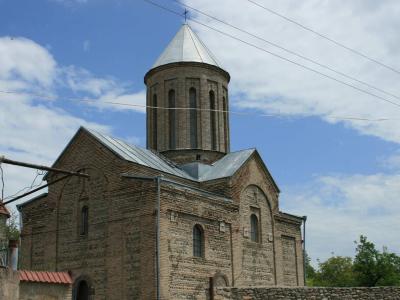
Nearby settlements