



Geguti Palace
Link copied
Photograph: Jaba1977 (CC BY-SA 4.0), Sopho Guliuashvili (CC BY-SA 4.0), Aleksey Muhranoff (CC BY-SA 3.0), 三猎 (CC BY-SA 4.0), Vladimer Shioshvili (CC BY-SA 2.0)
The only surviving royal palace of medieval Georgia, on the bank of the Rioni 7 kilometres from Kutaisi: ruins spread over 2,000 square metres, where Giorgi III raised a four-tier brick palace with a 14-metre dome on a 3-metre stone plinth over a hunting house of the eighth to ninth century, where Tamar was proclaimed co-ruler and where in 1191 rebel nobles crowned Yuri Bogolyubsky king.
About
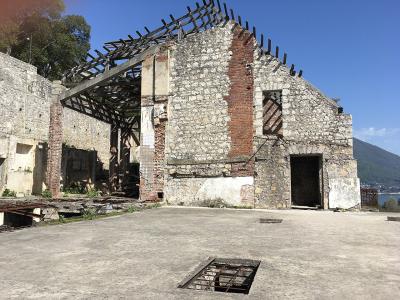
The Geguti palace stands in the village of Geguti, 7 kilometres south of Kutaisi, on the plain of the left bank of the Rioni, exactly where the Bagrationi court gathered for hunting and rest. The ruins cover more than 2,000 square metres and are the largest monument of secular architecture of feudal Georgia: hundreds of churches and monasteries have come down to us from the Middle Ages, but of palaces only this one.
Several building layers can be read in the complex. The earliest is the one-room hunting house of the eighth to ninth century with its great fireplace. Under Giorgi III (1156–1184) it received a three-metre plinth of dressed stone and a four-tier royal residence in brick. The heart of the building is a cruciform, four-armed central hall crowned by a dome 14 metres across resting on squinches, with an opening for light at its top; around it lay the bedchamber, the treasury, the strongroom and the bath. The palace was roofed with glazed tiles, its interior painted, and massive buttresses press against the walls outside. In the thirteenth to fourteenth century a new building and a palace church rose to the west, and a square circuit of walls and towers protected the whole.
In 2016 glass panels were set around the ruins with the original outline of the monument drawn on them, so that the visitor sees the brick walls and reads the full silhouette of the palace in the same frame. Since 7 November 2006 Geguti has been an immovable cultural monument of national significance.
- Century
- Hunting house of the 8th–9th century, royal palace of the 12th century (Giorgi III, 1156–1184), western building and church of the 13th–14th century
History
Geguti is first mentioned in the eighth century: in one manuscript of Juansher's Life of Vakhtang Gorgasali the prince of Kartli Archil says that he will settle in the fortresses of Geguti and Kutaisi. The main building of the palace belongs to the reign of Giorgi III, the Golden Age of Georgia, when the royal court acquired a permanent residence beside the second capital, Kutaisi. It was at Geguti that Giorgi III proclaimed his daughter Tamar co-ruler, and here in 1191 that the nobles who had risen against Tamar crowned her former husband, the Russian prince Yuri Bogolyubsky, king; the revolt collapsed. The Georgian chronicles name Geguti as a beloved resting place of the kings.
After the break-up of the united kingdom the palace served the kings of Imereti and is marked on the map of the kingdom of Imereti of 1737. It was damaged in the first half of the nineteenth century during the wars of Solomon II, and after the annexation of Imereti by the Russian Empire the destruction continued: officials carted the palace bricks away to put up buildings in Kutaisi. In 1833 the Swiss traveller Frédéric Dubois de Montpéreux drew a plan of the surviving part and worked out the purpose of the rooms.
The archaeological expedition of 1937 (Levan Muskhelishvili, the architect V. Tsilosani) cleared several rooms and recovered some 60 artefacts of different periods, now in the National Museum; the research of 1953–1956 made it possible to establish the architectural forms of the palace, and in 1954–1962 the complex was cleared and conserved under Vakhtang Tsintsadze. In 2006 the monument received national significance, and in 2016 the glass panels were installed.
Visit info
Geguti is 7 kilometres south of Kutaisi on the plain of the left bank of the Rioni, about 15–20 minutes by car; a marshrutka to the village of Geguti runs from the central bus station of Kutaisi, and you get off on the main road near the palace. The railway station of Rioni is 3 kilometres away. The ruins stand under the open sky, and the explanation and the original outline of the monument are on the glass panels. Half an hour to an hour is enough for the visit.
Safety
The walls are conserved, but climbing onto the plinth and standing at the open edges is dangerous: the brick is crumbly and a three-metre fall is enough. Keep an eye on children among the ruins. In summer there is no shade on the plain, so carry water and a hat; after rain the grassy yard is slippery.
Tip
The silhouette drawn on the glass panels lines up with the walls differently from different angles, so walk round and frame the shot so that the line meets the brick. In the morning and evening the brick glows red, while the midday sun washes the colour out. Geguti combines easily in a day with Bagrati and Gelati, or with Tskaltubo.
Sources
Nearby places
All places in the region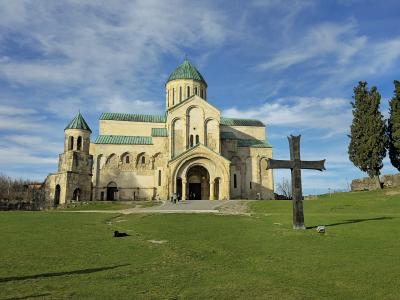
Places of the same kind
Palace — all places
Nearby settlements