



Gelati Monastery
Link copied
Photograph: Matthias Bethke (CC BY-SA 4.0), Jaba1977 (CC BY-SA 4.0), Anonymous, Gelati Monastery, Kutaisi, Georgia (Public domain), Kober (CC BY-SA 4.0), Unknown author (CC0), Bernard Gagnon (CC BY 4.0)
The royal monastery and academy founded by David the Builder in 1106, 11 kilometres from Kutaisi: a "new Hellas" with Ioane Petritsi and Arsen Ikaltoeli, the mosaic of 1125–1130 in the church of the Virgin, frescoes of the twelfth to eighteenth centuries, the burial place of the kings of Georgia and Imereti with David the Builder's grave and the Ganja gate at the southern entrance; a UNESCO World Heritage site since 1994.
About
Gelati is a Georgian architectural ensemble and the foremost cultural centre of medieval Georgia, 11 kilometres north-east of Kutaisi on a hill above the gorge of the Tskaltsitela, enclosed by a wall; the name may come from the Gennath gate of Jerusalem. The main church of the Dormition of the Virgin is a central-domed building, its dome resting on two piers and the walls of the sanctuary, with three faceted apses on the east, a narthex on the west and chapels on the south and north; with its annexes the church measures about 35 by 36 metres and stands up to 34 metres high, faced with dressed Eklari stone, its façades worked with decorative arcades of complex rhythm and almost without carving, while the wide and brightly lit interior is wholly covered with painting of different periods. The conch of the sanctuary holds the famous Gelati mosaic, the Virgin and Child between the archangels in the Byzantine style of 1125–1130, held the finest in the South Caucasus; the western narthex has twelfth-century frescoes of a church council, the southern chapel two thirteenth-century portraits of David Narin, and the northern wall sixteenth-century portraits of the royal family of Imereti and an image of David the Builder, restored in the sixteenth century after the old painting.
East of the main church stands the twelfth-century church of St George, repeating the main church in plan on a smaller scale, with sixteenth-century painting; nine metres away rises the two-storey church of St Nicholas of the thirteenth to fourteenth century, its lower storey open on all four sides by arches and the upper a small cruciform church; to the north-west is the thirteenth-century bell tower, whose arched pavilion is built over a spring. The ensemble includes the ruins of the academy, a rectangular building of about 300 square metres with three entrances on the east, a richly decorated porch added later, stone benches along the walls and painted walls. At the main entrance in the southern wall is the grave of David the Builder, and beside it the iron gate of Ganja brought back as booty by Demetre I in 1138; 150 metres outside the wall are the ruins of the Sokhasteri, the hermits' dwelling, to the south-west the remains of the hall church of St Saba of the tenth to eleventh century, and on "David's cape" in the Tskaltsitela gorge the ruins of the round tower that guarded the monastery.
- Tradition / order
- Georgian Orthodox Church; a working monastery and a branch of the Kutaisi museum
- Dress code
- Headscarf and skirt for women, long trousers for men; both are lent at the entrance
History
Gelati was founded in 1106 at the initiative of David the Builder, when Kutaisi was the capital of Georgia, and was conceived from the start as both a monastery and a seat of learning: the king gathered here Georgian scholars and philosophers who had worked in monasteries abroad, among them the Mangana monastery in Constantinople, and the academy, which contemporaries called "a new Hellas" and "a second Athos", was graced by Ioane Petritsi, the commentator on Proclus, and Arsen Ikaltoeli, author of the "Dogmatikon". The main church was completed in 1130 under Demetre I, and the monastery became the property and burial ground of the royal house: here were buried David the Builder, Demetre I, Giorgi III and, by the account of her historians, Tamar, and later the kings of Imereti Bagrat III, Giorgi II, Alexander V, Solomon I and Solomon II. In the twelfth to fifteenth centuries the monastery enjoyed full autonomy, acknowledging only the supreme right of the king, and its chief confessor sat in the royal council; the invasions of the Mongols and of Timur set its life back. On 23 November 1510 the Ottomans who had broken into Imereti burnt Gelati; the kings of Imereti Bagrat III, the "second builder" to his contemporaries, and Giorgi II thoroughly repaired and painted the churches, in the 1520s an episcopal see was founded at Gelati, and in the second half of the century the residence of the Catholicos of western Georgia moved from Bichvinta to Gelati, where it stayed until 1814. At the end of the eighteenth century the monastery held 42 villages; in 1810, after the abolition of the Kingdom of Imereti, it became a state monastery.
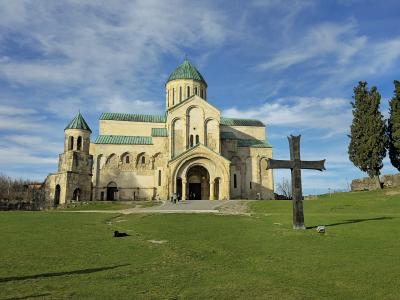
For centuries Gelati kept illuminated manuscripts and masterpieces of chased metalwork, among them the Khakhuli triptych of the Virgin, stolen in 1859 and returned damaged in 1923. In 1923 the monastery was closed and made a branch of the Kutaisi historical and ethnographic museum; worship was restored after independence. In 1994 Gelati was inscribed on the UNESCO World Heritage List together with Bagrati Cathedral, in 2006 it received the status of a monument of national significance, from 2010 to 2017 it stood on the List of World Heritage in Danger because of the reconstruction of Bagrati, and since 10 July 2017 it has been listed on its own, independently of Bagrati. From 2003 to 2016 the US Ambassador's Fund financed five restoration projects (600,000 dollars in 2013 for the roof and frescoes), yet the tiles of the newly roofed church cracked, water got in and soaked the wall painting, and fragments fell away; the damage that came to light in 2020, which specialists say cannot be undone, provoked public protest and an investigation.
Visit info
Gelati is 11 kilometres north-east of Kutaisi in the direction of Tkibuli, about 20 minutes by car or taxi, and also reached by marshrutka from Kutaisi; parking is by the wall. The monastery is in use and open by day, entry is free and the dress code applies. Motsameta is close by, 6 kilometres from Kutaisi, and combines with it in one visit.
Safety
This is a working monastery: dress rules are observed, photography during services is avoided, and no flash is used near the frescoes. The edge of the wall and the slope of the gorge are unguarded, and the paving is slippery after rain.
Tip
The apse mosaic shows best in morning light, so come early. South of the enclosure, in the main entrance, lies the grave of David the Builder, and beside it the Gate of Ganja, carried off by Demetrius I in 1138. The academy building and the thirteenth-century bell tower, whose lower arcade is built over a spring, stand in the yard. Gelati, Motsameta and Bagrati combine easily in one day from Kutaisi.
Sources
Nearby places
All places in the region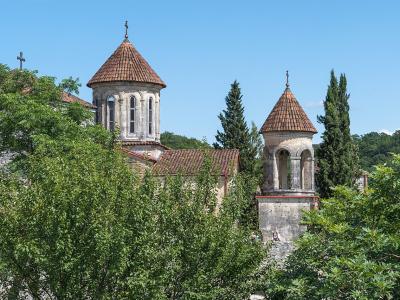
Places of the same kind
Monastery — all places
Nearby settlements