



Nikortsminda Cathedral
Nikortsminda Ambrolauri Municipality Racha-Lechkhumi and Kvemo Svaneti
Link copied
Photograph: Lasha (CC BY-SA 4.0), Al-o (CC BY-SA 3.0), Yasuhiro Kojima (CC BY-SA 2.0), Natia Maisashvili (CC BY-SA 4.0), John Mason Neale (Public domain)
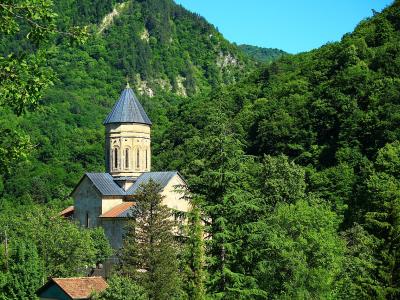
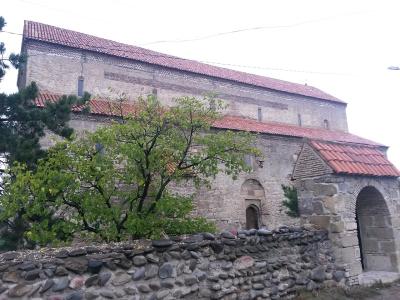
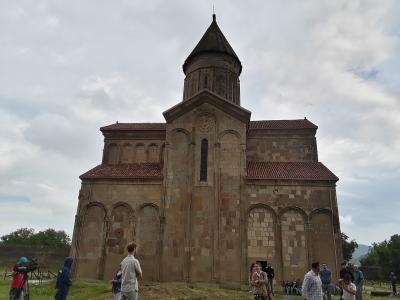
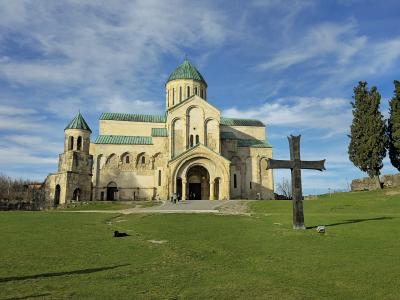
The principal church of Racha and one of the summits of Georgian stone carving: a six-apse domed church of St Nicholas raised in 1010–1014 on the order of Bagrat III and standing almost unchanged to this day, with the Transfiguration, the Second Coming and the Exaltation of the Cross on its façades, a 12-window drum, frescoes of the sixteenth and seventeenth centuries, the seat of the bishops of Racha from 1534 and a monument on the UNESCO tentative list since 2007.
About
Nikortsminda stands on the northern slope of the Racha range above the Shaori reservoir, 14 kilometres south-west of Ambrolauri. The church was raised in 1010–1014 on the order of Bagrat III, the first king of united Georgia: the inscription above the west door blesses the king and his heir and confirms the date of building. Dedicated to St Nicholas, it became the cultural centre of the eristavate of Racha created at the end of the tenth century, and it is a rare monument that has suffered no substantial change in a thousand years: the dome survives in its original form.
In plan the church is a short-armed rectangular cross on the outside and a six-apse building within: five semicircular apses with a rectangular western arm, while the altar bema and the western arm stretch the space along the east–west axis. On the half-column projections of the apses rises the massive drum, which passes from a hexagon to a circle by means of pendentives; its 12 windows flood the interior with light. The façades are faced with finely cut stone and worked with an unbroken arcade, and carved borders run round the windows. It is the carving and the reliefs that set Nikortsminda apart: the Transfiguration on the east façade, the Second Coming of Christ and the Exaltation of the Cross on the south gable, St George and St Theodore beside them, real and fantastic animals, many-figured scenes and a cross in rays on the vault. Folk motifs from pre-Christian belief mingle with the Christian subjects. The south and west porticoes were added later, but still in the first half of the eleventh century.
Inside are two layers of painting of the sixteenth and seventeenth centuries: saints, church scenes and many portraits of lay figures with inscriptions, since in the late Middle Ages Nikortsminda was the burial place of the local princes, the Tsulukidze. During the rehabilitation of 2012, frescoes of the sixteenth century unknown until then emerged from under the soot of the porticoes: the donors, local nobles, the Archangel Michael and the name of the painter, one Javakhadze. The three-storey bell tower in the yard was built in the second half of the nineteenth century, while of the stone wall described by Russian envoys in the 1650s only remains survive. Since 24 October 2007 Nikortsminda has been on the UNESCO World Heritage tentative list; Galaktion Tabidze dedicated to it his Song of Songs to Nikortsminda.
- Century
- 1010–1014 (Bagrat III), porticoes in the first half of the 11th century, renewal in 1534, bell tower in the second half of the 19th century
- Dress code
- Headscarf and skirt for women, long trousers for men
History
The building of the church followed the founding of the eristavate of Racha: by 1010 Bagrat III had taken Rani and laid the foundation of a great church of St Nicholas in the newly created province. In the eleventh to thirteenth centuries Nikortsminda was the family monastery of the eristavis of Racha, the Kakhaberidze, as several inscriptions attest, among them that of Kakhaber, who had an icon of the Crucifixion chased for the health of his son Rati, eristavi of Racha. In the 1280s David VI Narin, king of western Georgia, exterminated the Kakhaberidze on a charge of treason, and Nikortsminda lost its protector.
In the 1530s King Bagrat III of Imereti renewed the church: his charter of 1534 is the witness of that care, and from then on Nikortsminda was the episcopal seat of Racha. The interior was painted in the sixteenth century, and in the second half of the seventeenth a second layer of painting was paid for by the Tsulukidze, whose burial place the church became. In 1650–1652 the Russian envoys Tolochanov and Ievlev, sent to Imereti, described a stone church "great and wondrous", a wall with two gates and tombs set into the walls; the tombs were covered over at a later renewal.
In 1947 Giorgi Chubinashvili and Nikolai Severov published Nikortsminda together with Kumurdo as a monograph, and in 1957 Natela Aladashvili studied the reliefs on their own. The Racha earthquake of 1991 damaged the church and it was restored; on 24 October 2007 it entered the UNESCO tentative list, and the rehabilitation of 2012 revealed the sixteenth-century frescoes of the porticoes. Today the church is the cathedral of the eparchy of Nikortsminda and is in use.
Visit info
Nikortsminda is 14 kilometres south-west of Ambrolauri, and about 70 kilometres and an hour and a half from Kutaisi by way of Tkibuli and the Nakerala pass; the village stands on that road, above the Shaori reservoir. Marshrutkas to Ambrolauri run from the Kutaisi bus station. The church is a working cathedral, open by day, free to enter, with parking by the yard; the dress code is strict. Services are held on Sundays and feast days, and St Nicholas is celebrated on 19 December and 22 May. An hour is enough for the visit.
Safety
On the Nakerala pass the road is icy in winter and fog is frequent, so winter tyres are needed and the weather should be checked in advance. This is a working church: photography is avoided during services and the sanctuary is not entered. Watch children at the edge of the yard.
Tip
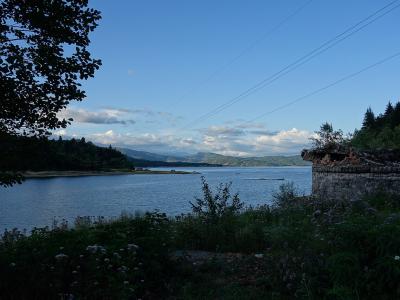
The reliefs on the east and south façades read best in the low morning sun: the Transfiguration to the east, the Second Coming and the Exaltation of the Cross on the south gable, animals and saints around the windows; bring binoculars or a long lens. Inside, look for the portraits of the Tsulukidze and the frescoes of the porticoes revealed in 2012. From the edge of the yard the Shaori reservoir and the Nakerala range come into view. In a day Nikortsminda combines with Shaori, Barakoni and the Minda fortress.
Sources
Nearby places
All places in the region
Places of the same kind
Cathedral — all places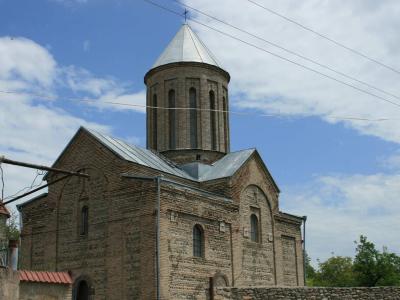
Nearby settlements