



Martvili Monastery
Link copied
Photograph: Kober (CC BY-SA 4.0), Алла Лебедева (CC BY-SA 2.0)
The seventh-century cathedral of Martvili-Chkondidi on the site of a pagan oak, on the hill above Martvili: from the tenth century the seat of the bishops of Chkondidi and a centre of Georgian letters, a building of the Jvari of Mtskheta type with frescoes of the fourteenth to seventeenth centuries, the burial place of the Dadiani, a monastery revived in 1998 and reached from the town by cable car.
About
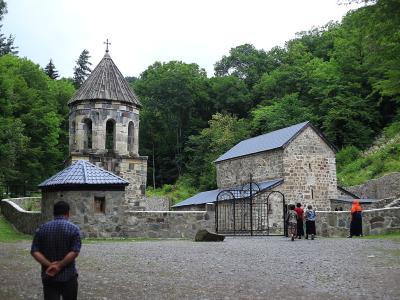
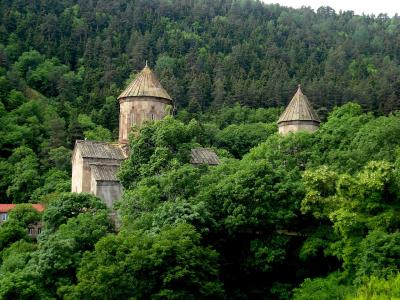
The Martvili Monastery stands near the centre of Martvili Municipality on the crest of a hill thrust out like a headland, from which the plains of the Tskhenistskali and the Abasha and almost all of Imereti and Mingrelia can be seen; the complex is enclosed by a wall, and the main church is dedicated to the Dormition of the Mother of God. From time immemorial the site was a pagan shrine: on the hill stood a huge oak, in Mingrelian chkoni, the idol of Kapunia, protector of fertility and the well-being of the family, to which the priests, the chkoindari, sacrificed infants; after the conversion to Christianity the oak was cut down and the first church, in the name of Andrew the First-Called, built on its roots. At the end of the seventh century the cathedral of Martvili-Chkondidi rose, its altar founded on the buried relic, the roots of the felled oak.
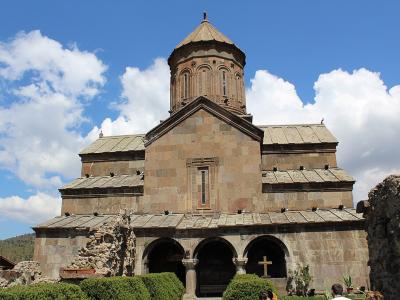
In plan the church is a tetraconch of the type of the Jvari of Mtskheta, but it does not copy it: the architect reduced the diameter of the dome and enlarged the corner niches, deepened the arms of the apses, widened the corner rooms and gave the squinches that carry the transition from square to polygon a stepped form of small arches hung one over another, so that despite its smaller size he created an independent work of art; the conical dome rests on the walls of its drum. In the tenth century the arms of the cross were taken down and chapels added, only the faceted projecting apse on the east surviving untouched, with a deep niche on either side; the Russian scholars Vinogradov and Kosourov see in the façade decoration an imitation of the Holy Cross church of Aghtamar. Inside are frescoes of the fourteenth to seventeenth centuries and portraits of the Chikovani; north of the cathedral stands a small two-storey building with a domed church on its upper floor, and to the south-west the ruins of the so-called pillar, where by a historian's account a stylite lived at the beginning of the eleventh century.
- Tradition / order
- Georgian Orthodox; monastery of the Chkondidi eparchy
- Dress code
- Shoulders and knees covered; a headscarf and skirt for women
History
Turkish and Arab invasions badly damaged the seventh-century cathedral, and in the tenth century Giorgi II, king of the Abkhazians, had it thoroughly rebuilt; "Kartlis Tskhovreba" credits him with building the church at Chkondidi, founding the bishopric and adorning it with the relics of many martyrs. Thereafter the church kept the name Martvili and its bishops the title Chkondideli. In the tenth century the hymnographer Ioane Minchkhi worked here, Bagrat IV assigned the see of Chkondidi to Giorgi Mtatsmindeli, and by the account of "Kartlis Tskhovreba" Bagrat IV himself is buried in the Martvili monastery. The monastery had a scriptorium, the quarters of the copyist monks, where books were translated and original works composed; among its men of letters was Giorgi Chkondideli of the eleventh century, the tutor of David the Builder.
In the eighteenth century, when the Chikovani branch ruled Mingrelia, the church became the burial place of the Dadiani, and in 1903 Niko Dadiani, the last prince of Mingrelia, was buried here. In the Soviet period the monastery was closed; it was revived in 1998. On 7 November 2006 the church was entered in the list of immovable cultural monuments of national significance of Georgia; a cable car rises to the monastery from the centre of the town.
Visit info
The monastery stands on the hill above the centre of Martvili, reached from the town by car or by cable car; Martvili is 50 kilometres from Kutaisi and about 35 from Senaki. It is a working monastery of the Chkondidi eparchy; check opening times locally.
Safety
This is a working monastery: dress modestly, do not touch the frescoes, and ask before taking photographs inside. Take care near the edges of the hill.
Tip
See from outside the east apse, the only untouched part of the seventh-century church, and the relief friezes of the façades; inside, look for the portraits of the Chikovani and the Mother of God in the conch of the altar apse. From the crest the view opens over the plains of Imereti and Mingrelia. The monastery fits into half a day with the Martvili canyon.
Sources
Nearby places
All places in the region
Places of the same kind
Monastery — all places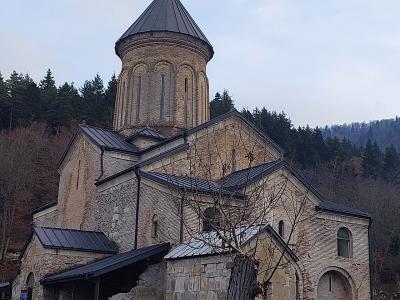
Nearby settlements