



Nokalakevi (Archaeopolis)
Link copied
Photograph: G.N. (CC BY-SA 3.0), Aleksey Muhranoff (CC BY-SA 3.0), Gaga.vaa (CC BY-SA 4.0)
Tsikhegoji, capital of the Kingdom of Egrisi (Lazica), the Archaeopolis of the Byzantines, in a loop of the Tekhuri: three walls, a citadel, royal palaces, baths and a basilica, excavated systematically since 1973 and studied by the Anglo-Georgian expedition since 2001, with a museum on the site.
About
Nokalakevi, "the site of a former city" in Mingrelian, is a historic fortress town in Senaki Municipality, 15 kilometres from Senaki on the Martvili road, on the northern edge of the Colchian plain on the left bank of the Tekhuri. Byzantine historians called it Archaeopolis, the "old city", and the Georgian chronicles Tsikhegoji, the fortress of Kuji, the eristavi of Egrisi who built it at the beginning of the third century BC; some scholars have also identified it with Aia, the Colchian capital of the Argonaut myth. The fortress commanded the crossing of the Tekhuri and the junction with the road to Chkhorotsku.
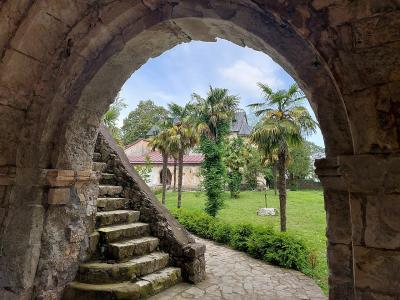
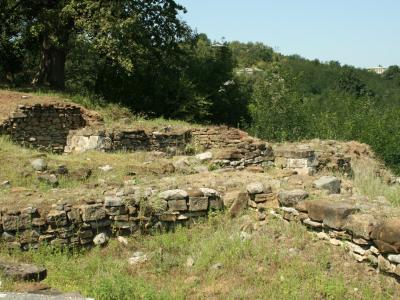
The site covers some twenty hectares in three parts: the main, lower town on the river bank, the garrison quarter on the slope and the citadel on the summit, more than three hectares with two towers, one of them, the "Jikha", watching the Colchian plain and the north. The defences follow the terrain: on the river and cliff sides a single wall, on the easily approached eastern side three parallel walls, and a wall joining the upper and lower towns. In the lower town excavation has revealed a fourth-century palace of the kings of Egrisi, a fifth-century three-aisled basilica, a small basilica of the early sixth century later converted into a domed church (the church of the Forty Martyrs), a second, three-storey royal palace, a towered gate and two baths, one of them a large and complex building with central heating. The buildings are of dressed or lightly worked stone; beneath the layers of the fourth to sixth centuries lie several phases of settlement and abandonment from the eighth to the second century BC, and the trenches hold up to 3.5 metres of stratified deposits.
The excavations have yielded rich material: local and imported pottery, including amphorae of the fourth to seventh centuries, a cemetery of pithos burials of the fourth and third centuries BC with Colchian tetri placed in the mouths of the dead, a Hellenistic kantharos and a black-glazed cup, bronze bracelets and beads, a lead seal with a cruciform monogram, arrowheads and spearheads, copper and gold coins, and a hoard of 23 gold solidi struck in the name of the Byzantine emperor Maurice (582–602). On the site is the Nokalakevi Archaeological Museum-Reserve, and on the right bank of the Tekhuri natural hot springs rise.
- Period
- Settlement of the 8th–2nd century BC; capital of the Kingdom of Egrisi in the 4th–8th century; Dadiani residence in the 16th–18th century
- Excavations/notes
- 1930–1931 German-Georgian expedition (A.-M. Schneider); from 1973 the state expedition (Parmen Zakaraia); from 2001 the Anglo-Georgian expedition (Lomitashvili, Colvin, Everill, Murgulia)
History
Traces of life at Nokalakevi appear from the beginning of the first millennium BC and become intensive from the fifth and fourth centuries BC. In the fourth to eighth centuries Tsikhegoji was the capital of the Kingdom of Egrisi and one of the chief theatres of the Lazic War of 542–562: for Byzantium and Lazica it was the key fortress guarding the kingdom from Sasanian, Persian and Iberian attack; the Persians assaulted it three times and took it only on the third, in 554, but the Byzantine and Laz forces soon recovered it, and the Persians' failure to hold it eventually cost them control of Lazica. In 737–738 the Arab commander Marwan the Deaf destroyed the city, and its people fled towards the Enguri or perished; Tsikhegoji dwindled to a small village. In the sixteenth century the prince of Odishi built a palace here, and from the sixteenth to the eighteenth century Nokalakevi was a residence of the Dadiani.
Modern study of the site began in 1833–1834 with the Swiss Frédéric Dubois de Montpéreux, who identified the ruins as the Archaeopolis of the Byzantines and, at the same time, as the Colchian Aia; in the 1840s David Dadiani, prince of Mingrelia, dug here himself and exhibited the finds in his palace at Zugdidi. In the winter of 1930–1931, on the initiative of Ivane Javakhishvili, a German-Georgian expedition under Alfons-Maria Schneider of Freiburg traced the line of the walls, dug some forty survey trenches and one tower, and with a hoard of gold solidi of the emperor Maurice confirmed the identification with Archaeopolis, though the question of Aia stayed open, most scholars identifying Aia with Kutaisi. In 1973 a state expedition was set up under Parmen Zakaraia, which carried out large excavations and conservation until the early 1990s, when the collapse of the Soviet Union and civil unrest cut off funding and damaged the expedition's base. In 2001 David Lomitashvili of the Janashia Museum and Ian Colvin of Cambridge University resumed large-scale excavation: the Anglo-Georgian expedition, co-directed on the British side by Colvin and Paul Everill and on the Georgian side by Nikoloz Murgulia, marked its twentieth anniversary in 2020 and has trained some 250 Georgian and British students; the seasons of 2001–2010 were published as a separate volume in 2014. On 7 November 2006 the site was listed as an immovable cultural monument of national significance.
Visit info
Nokalakevi is 15 kilometres from Senaki on the Martvili road; the buildings of the lower town, the basilica, the baths and the walls lie on the river bank, and the citadel crowns the ridge above them. The archaeological museum on the site displays the finds. On the right bank of the river are natural hot springs.
Safety
The citadel path is steep and runs close to cliff edges; do not climb the walls or approach open trenches. There is little shade in summer, so take water and a hat.
Tip
See the museum first and the site after, so that the plan reads better; give the climb to the citadel an hour, since from the top the loop of the Tekhuri and all three walls show together. The Anglo-Georgian expedition digs here during the summer seasons. Nokalakevi fits into one day with the Martvili canyon and monastery.
Sources
Nearby places
All places in the region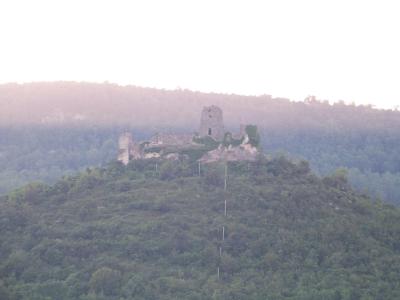
Places of the same kind
Archaeological Site — all places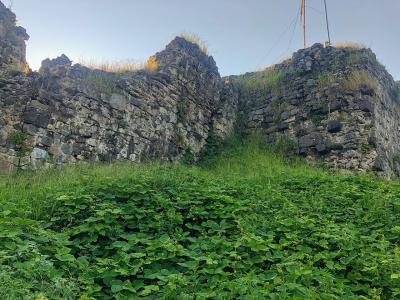
Nearby settlements