



Shkhepi Fortress
Link copied
Photograph: Jaba1977 (CC BY-SA 4.0), ლიკა აბრალავა (CC BY-SA 3.0), Marie-Frédéric Dubois de Montpéreux (Public domain)
A medieval fortress near Senaki, with four building layers from the early fourth to the seventeenth century, two gates, three towers, a hall church and a defensive ditch: the place where King Levan of Imereti died in captivity in 1590, the castle of the Chiladze lordship, proposed as the Egrisian fortress of Onoguris; a monument of national significance since 2006.
About
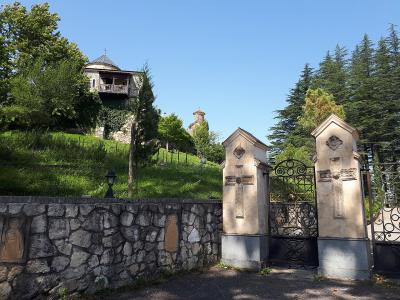
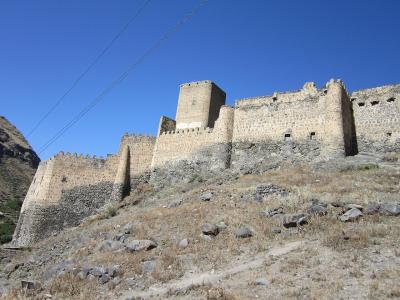
The Shkhepi fortress stands in Mingrelia near the town of Senaki. It is a medieval fortress in which four building layers are distinguished, the earliest of the early fourth century and the latest of the sixteenth and seventeenth, with traces of later alterations. In plan the fortress is oblong and stretched along an east-west line; it consists of two gates cut in the eastern stretch of the wall, three towers, the south-western, the central and the south-eastern, a small hall church built against the northern wall in the north-eastern corner, a water cistern and the curtain wall, and an artificial defensive ditch surrounds it. The walls are of quarried rubble in lime mortar laid in courses. The south-western and central towers are rectangular, the central one a four-storey structure in the shape of a truncated pyramid with its entrance cut on the south at a height of 4 metres; the third tower, set into the south-eastern corner, is round and three storeys high, entered at ground level from the west, and scholars take it to have been a dwelling. The apsed hall of the church is enclosed in an outer rectangle, with the entrance on the west and the apse at the eastern end.
- Construction period
- Four building layers, from the early 4th century to the 16th–17th centuries
- Material
- Quarried rubble stone in lime mortar, laid in courses
History
It has been proposed that the Shkhepi fortress is Onoguris, the fortress of the kingdom of Egrisi named in the chronicles of the Byzantine-Persian wars of the sixth century, whose location scholars still debate: Onoghia, Sepieti and Khuntsistsikhe in Martvili Municipality have also been put forward. The earliest layer of the fortress is of the early fourth century. Until the middle of the sixteenth century Shkhepi belonged to the lordship of the Chiladze family and was often used as a prison for prisoners of rank: in 1590 King Levan of Imereti died here in captivity. The fortress was still in use at the start of the nineteenth century.
In 1979 archaeological excavations were carried out at the fortress and I. Adamia published the monument in "Dzeglis Megobari"; Parmen Zakaraia describes it in his corpus of Georgian fortresses. On 7 November 2006, by decree of the President of Georgia, the Shkhepi fortress was granted the category of an immovable cultural monument of national significance (cultural heritage portal no. 5154).
Visit info
The fortress stands near Senaki. Check the way up to the ruins and the conditions of visiting locally.
Safety
Do not climb the walls; a defensive ditch surrounds the fortress, so watch your step.
Tip
Look for the round south-eastern tower and the entrance to the central tower cut 4 metres up, and the small hall church built against the northern wall.
Sources
Nearby places
All places in the region
Places of the same kind
Fortress — all places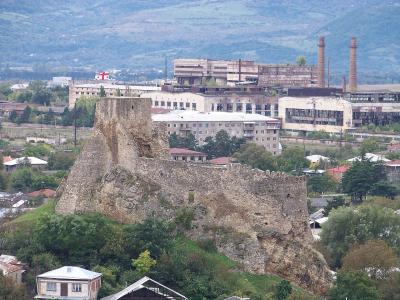
Nearby settlements