

Places in Georgia

Fortresses, churches, national parks, waterfalls and museums, each with its history, location and map.

places
127
categories
24
regions
11

20 places shown · all on one page

Places are now sorted by distance, nearest first.

No place by that name.

Your location could not be found, so the places keep their usual order.

  • Monastery

    Kintsvisi Monastery

    Kareli Municipality, Shida Kartli

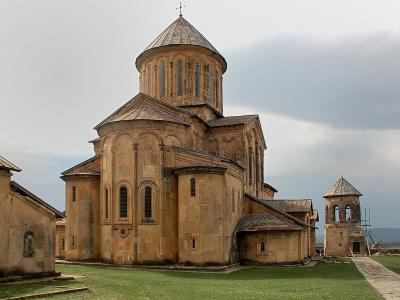
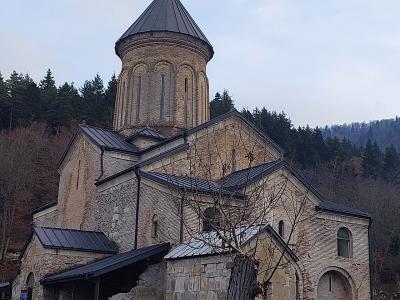
    A medieval monastery in Kareli municipality, on a forested slope of the Dzama valley, 3 kilometres from the village of Qintsvisi. Its main church of St Nicholas, a brick domed building of the early thirteenth century, holds one of the largest and best-preserved medieval Georgian wall paintings: portraits of Giorgi III, Queen Tamar and Giorgi IV Lasha, the celebrated Kintsvisi Angel and backgrounds coloured with lapis lazuli. Beside it stand the small church of St George and the ruins of the church of the Virgin.
  • Monastery

    Timotesubani Monastery

    Borjomi Municipality, Samtskhe-Javakheti

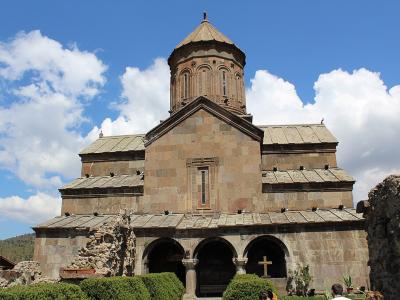
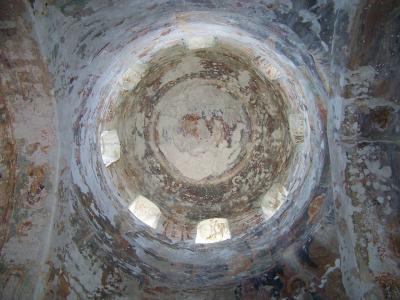
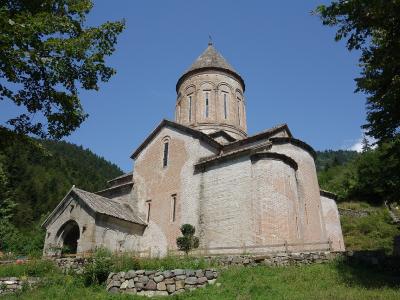
    A monastery of the Mother of God in the village of Timotesubani in Borjomi municipality, 18 kilometres from Borjomi, on the right bank of the Gujaretistskali river. Its main church, of the Dormition, was built at the turn of the twelfth and thirteenth centuries by Shalva Akhaltsikheli, lord of Tori, in pinkish “Georgian brick”; inside are wall paintings of 1205–1215, among the most complex of their time, whose conservation won a Europa Nostra medal in 2006.

  • Monastery

    Vanis Kvabebi

    Aspindza Municipality, Samtskhe-Javakheti

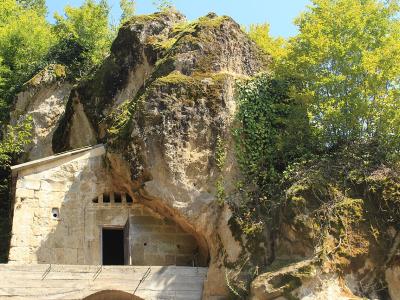
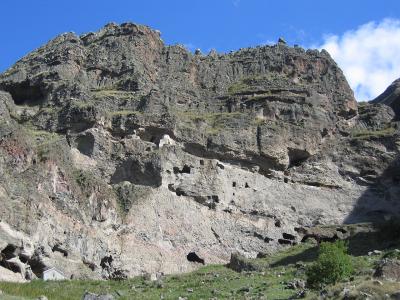
    A rock-cut desert monastery in Aspindza municipality, on the right bank of the Mtkvari, 27 kilometres from Aspindza: a monument of the eighth–sixteenth centuries, with up to 200 caves arranged on 16 levels. The oldest caves date from no later than the eighth century, the domed church of Saint George stands at the centre, and a wall restored in 1204 closes off the monastery yard. On the walls of a small church on the top level are poems written in ink by women in the fifteenth century, among them two stanzas of The Knight in the Panther's Skin.

  • Advertisement
  • Monastery

    Zarzma Monastery

    Adigeni Municipality, Samtskhe-Javakheti

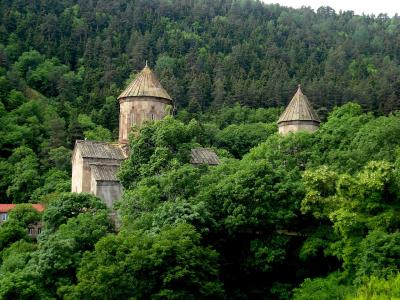
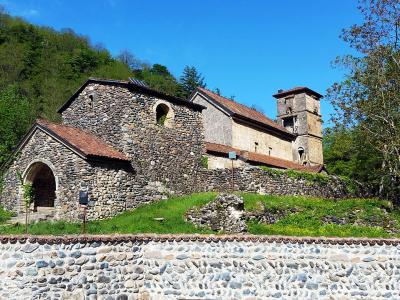
    A medieval monastery in the village of Zarzma in Adigeni municipality, in the forested valley of the Kvabliani river, 8 kilometres from Adigeni and 30 kilometres from Akhaltsikhe. It was founded in the eighth–ninth centuries by Serapion of Zarzma, while the present domed church and bell tower were built at the start of the fourteenth century, in the time of Beka I Mandaturtukhutsesi. The church holds portraits of the Jaqeli family and of historical figures of the sixteenth century, and the bell tower is one of the largest in Georgia. Today it is a working monastery.

  • Monastery

    Sapara Monastery

    Akhaltsikhe Municipality, Samtskhe-Javakheti

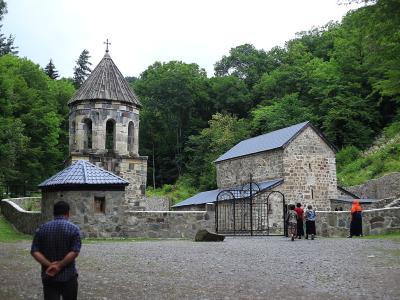
    A medieval monastery in a forested gorge near the village of Ghreli, 10 kilometres from Akhaltsikhe: one of the residences of the Jaqeli lords of Samtskhe and their family burial place. Here stand the tenth-century church of the Dormition, the domed church of St Saba built under Beka Jaqeli at the turn of the thirteenth and fourteenth centuries, one of the oldest bell towers in Georgia, the ruins of a palace and a castle, and fourteenth-century frescoes with portraits of the Jaqeli princes. Today it is a working monastery.

  • Monastery

    Green Monastery

    Borjomi Municipality, Samtskhe-Javakheti

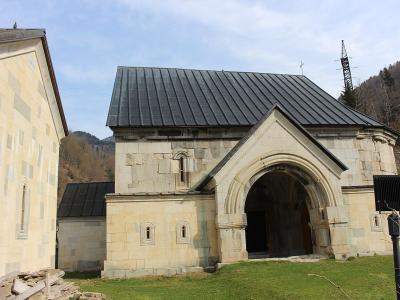
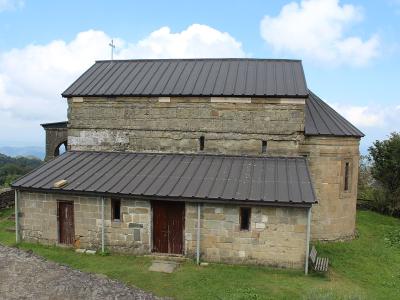
    The monastery of St George at Chitakhevi, popularly called the Green Monastery, stands in a narrow wooded gorge in the village of Chitakhevi in Borjomi municipality, in the south-western part of Borjomi-Kharagauli National Park. The complex consists of a three-nave basilica of the ninth–tenth century and a two-storey bell tower of the fifteenth–sixteenth century. Monks returned in 2003 to the monastery, abandoned for more than two hundred years; the church and the bell tower are Immovable Cultural Monuments of National Significance.

  • Monastery

    Skhalta Cathedral

    Khulo Municipality, Adjara

    A large medieval hall church in the village of Qinchauri in Khulo municipality, in the valley of the Skhalta river, 100 kilometres from Batumi: the centre of the eparchy of Skhalta, with fragments of Palaiologan wall painting of the fourteenth–fifteenth century and a rare image of John the Baptist as a youth; the only medieval church in Adjara that survived both the Ottoman and Soviet periods and became active again in 1990. Its date is disputed: the twelfth century or the middle of the thirteenth.

  • Monastery

    Mghvimevi Monastery

    Chiatura Municipality, Imereti

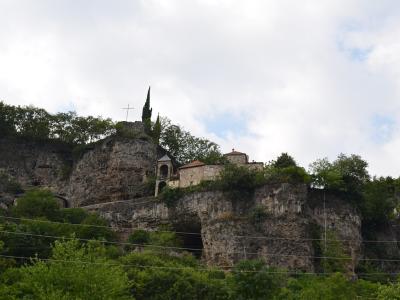
    A nunnery cut into the cliff of the Kvirila valley on the eastern edge of Chiatura, founded in the second half of the thirteenth century by Rati Kakhaberidze, eristavi of Racha, his wife Rusudan and his brother Niania: a two-nave basilica of the Nativity of the Mother of God resting on a single massive pillar, a painted wooden iconostasis of the eighteenth century, the eleventh-century Vine Door and Supplication icon now in the National Museum, the rock church of St Catherine with its ram's head, and a great cave where the liturgy is sung on feast days.

  • Monastery

    Ubisa Monastery

    Kharagauli Municipality, Imereti

    Gregory of Khandzta's ninth-century monastery of St George in the Dzirula valley beside the Tbilisi–Kutaisi road: with Simon Chkondideli's four-storey tower-pillar of 1141, a twelfth-century wall and a unique cycle of fourteenth-century frescoes by the painter Damiane or his pupil Gerasime, the only complete example of the Palaiologan renaissance in Georgia; a hermitage known for its monks' honey.

  • Monastery

    Katskhi Pillar

    Chiatura Municipality, Imereti

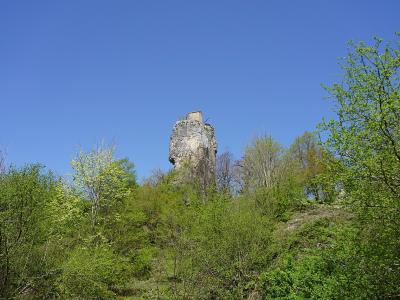
    A 40-metre limestone monolith in the Katskhura valley near Chiatura, the "Pillar of Life", on whose 150-square-metre top stood a hermitage of the ninth to tenth century: the church of Maximus the Confessor, a crypt, three cells and a wine cellar with eight kvevri, unclimbed until 1944, restored in 2005–2009 and inhabited for 20 years by the monk Maxime Kavtaradze; since 2012 climbing the pillar is forbidden.

  • Monastery

    Motsameta Monastery

    Tkibuli Municipality, Imereti

    The "place of the martyrs" on a rocky promontory in a bend of the Tskaltsitela, 6 kilometres from Kutaisi: the relics of David and Constantine Mkheidze, princes of Argveti, tortured to death by Murvan the Deaf in 735–737, whose blood turned the river into "red water"; Bagrat IV's eleventh-century monastery, renewed in 1844–1863 by the Berekashvili builders, with the reliquary, two wooden lions and the passage beneath it for pilgrims.

  • Monastery

    Gelati Monastery

    Tkibuli Municipality, Imereti

    The royal monastery and academy founded by David the Builder in 1106, 11 kilometres from Kutaisi: a "new Hellas" with Ioane Petritsi and Arsen Ikaltoeli, the mosaic of 1125–1130 in the church of the Virgin, frescoes of the twelfth to eighteenth centuries, the burial place of the kings of Georgia and Imereti with David the Builder's grave and the Ganja gate at the southern entrance; a UNESCO World Heritage site since 1994.

  • Monastery

    Udabno Monastery of Guria

    Chokhatauri Municipality, Guria

    The "Vardzia of Guria": a church of St John the Baptist half cut into the rock and hermits' caves on the slope of Mount Amaghleba on the southern flank of the Guria range, dated by scholars to the sixth or the ninth to tenth century, one of the oldest hermitages of Guria and the library of the ninth-century "Udabno Mravaltavi" and the Bakar Bible of 1743, whose church of 1858 the local authorities pulled down in 1958 for building stone.

  • Monastery

    Jumati Monastery

    Ozurgeti Municipality, Guria

    The monastery of the Archangels Michael and Gabriel on the Guria range above the Supsa valley at 492 metres, from which all of western Georgia comes into view: the bishopric of Jumati of the fifteenth to nineteenth centuries and the seat of the Guria diocese in 1844–1886, home of the eleventh-century icons of the archangels whose enamel medallions are today in the Metropolitan Museum in New York, the Hermitage and the Louvre.

  • Monastery

    Shemokmedi Monastery

    Ozurgeti Municipality, Guria

    The burial ground of the Gurielis and from the fifteenth century a metropolitan see, on a hill above the Bzhuzhi 7–8 kilometres from Ozurgeti: the thirteenth- to fourteenth-century basilica of the Saviour with the fresco of Mamia II Gurieli, the domed "Zarzma" church built in the 1570s for the Transfiguration icon of 886 rescued from Zarzma, and a bell tower renewed in 1831; a treasury of the Georgian church, whose surviving part is in the National Museum.

  • Monastery

    Martvili Monastery

    Martvili Municipality, Samegrelo-Zemo Svaneti

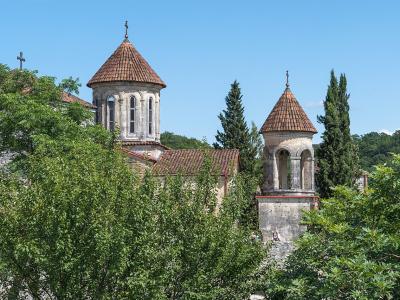
    The seventh-century cathedral of Martvili-Chkondidi on the site of a pagan oak, on the hill above Martvili: from the tenth century the seat of the bishops of Chkondidi and a centre of Georgian letters, a building of the Jvari of Mtskheta type with frescoes of the fourteenth to seventeenth centuries, the burial place of the Dadiani, a monastery revived in 1998 and reached from the town by cable car.

  • Monastery

    Khobi Monastery

    Khobi Municipality, Samegrelo-Zemo Svaneti

    A thirteenth-century hall church rich in stone carving in the village of Nojikhevi, 4 kilometres from Khobi: the family abbey and burial place of the Dadiani, with frescoes of the thirteenth and fourteenth and the seventeenth centuries and a chapel faced with Byzantine marble that Vameq I Dadiani brought from Zichia; for centuries the monastery kept the robe of the Mother of God; today a convent.

  • Monastery Occupied

    New Athos Monastery

    Gudauta Municipality, Abkhazia

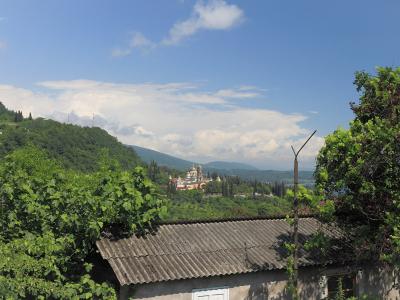
    A monastery built at the end of the nineteenth century by monks from Mount Athos at New Athos in Abkhazia, with the five-domed Cathedral of St Panteleimon, the largest church building in the region.

  • Monastery Occupied

    Otkhara Cave Monastery

    Gudauta Municipality, Abkhazia

    Caves cut in several tiers into a sheer cliff at the foot of the Bzyb range near the village of Otkhara, above the karst source of the Mchishta: by tradition a home of monks and later a refuge of brigands, first explored scientifically in 1958 and dated by its finds to the thirteenth and fourteenth centuries.

  • Monastery Occupied

    Kamani Monastery

    Sokhumi Municipality, Abkhazia

    A monastery north of Sukhumi in the village of Kamani, which tradition links with the death and first burial of St John Chrysostom: rebuilt in the 1980s on the foundations of a medieval church and marked by the tragedy of 1993.

Places by region

Pick a region to filter the list
Advertisement